
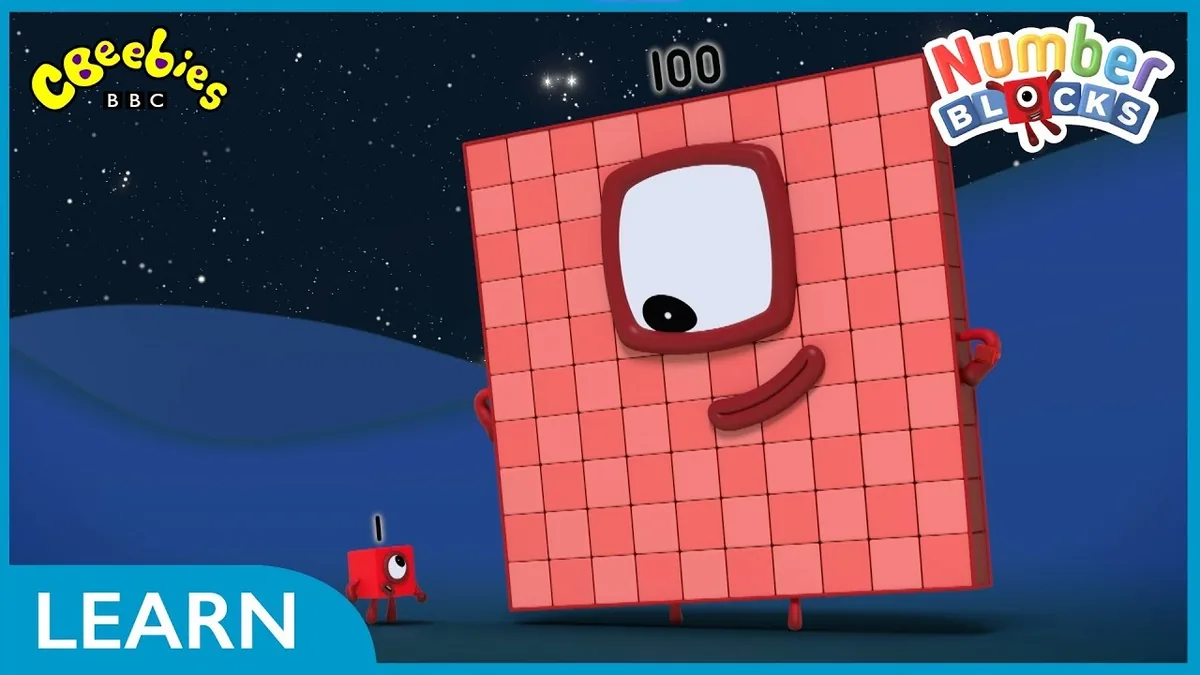
Who is One Hundred in Numberblocks?
In Numberblocks, each character makes a number visible through a quantity of blocks. One Hundred is the character for 100. The BBC’s Numberblocks Live Lesson guide refers to a final song from Numberblock One Hundred and describes the lesson as reaching 100 by building from smaller groups. That is a useful, checkable starting point for families looking up the Numberblocks 100 character.
The search phrase can also point to the episode or song named One Hundred, a video clip, or a picture of the character. Those results serve different needs. The official video below is the best place to see the show itself; the rest of this page is an independent maths guide that explains how 100 can be arranged and grouped.
For accuracy, keep the show reference and the arithmetic separate. The character represents 100, while the list of all possible rectangular arrays comes from the factors of 100. A particular multiplication model on this page is not a claim that the programme shows that exact formation in every episode or version.
Why does a 10×10 Numberblocks 100 square equal one hundred?
A 10×10 array has ten rows with ten cells in each row. Count one row as ten, then count ten rows by tens: 10, 20, 30, and so on until 100. The total is also 10 multiplied by 10. Each small square below stands for one unit, so the diagram contains one hundred units rather than a drawing of the official character.
Arrays are useful because they show two equal groups at once: rows and columns. Here there are ten groups of ten across the rows, and ten groups of ten down the columns. Turning the square does not change the count. It gives learners a way to connect repeated addition, multiplication and the idea that 100 is a square number.
This 10×10 picture is an explanatory number grid, not a printable 1-to-100 chart or a screenshot from Numberblocks. A chart usually labels cells in counting order; this grid emphasizes equal rows. If the task is counting every number from 1 through 100, use a dedicated number chart. If the task is to see how a quantity can be shaped, the array is the more direct model.
What are the factor pairs of 100?
A factor pair is two whole numbers that multiply to make the target. For 100, start with one group of 100 and test equal arrangements: two groups of 50, four groups of 25, five groups of 20, and ten groups of 10. Reversing a pair changes which side is called a row or a column, but it does not create a new rectangle.
The positive factors are 1, 2, 4, 5, 10, 20, 25, 50 and 100. They form five distinct pairs when orientation is ignored. The prime factorization is 100 = 2² × 5²; that follows because 100 = 10 × 10 and each ten is 2 × 5. You do not need prime factorization to understand the character, but it explains why these are all the whole-number factors.
Use the table to compare how wide or tall a rectangular arrangement would be. Ten by ten is balanced; one by one hundred is long and narrow. All five rows have the same area—100 units—so a layout changes the shape, not the amount.
| Pair | Multiplication | Equal-group meaning |
|---|---|---|
| 1 and 100 | 1 × 100 = 100 | One group of one hundred |
| 2 and 50 | 2 × 50 = 100 | Two equal groups of fifty |
| 4 and 25 | 4 × 25 = 100 | Four equal groups of twenty-five |
| 5 and 20 | 5 × 20 = 100 | Five equal groups of twenty |
| 10 and 10 | 10 × 10 = 100 | Ten equal groups of ten; a square array |
How can you make 100 with Numberblocks tens?
Multiplication arrays are equal groups, but addition can combine groups of different sizes. The BBC teacher guide gives four ways to reach 100: ten sets of 10 blocks, two sets of 50 blocks, five sets of 20 blocks, or one hundred blocks of 1. Those examples use equal-sized groups and are easy to model with counters, cubes or a sketch.
Other sums can make 100 too. For example, 50 + 30 + 20 = 100 and 10 + 20 + 30 + 40 = 100. These are valid partitions, but they are not factor pairs because the groups are not all the same size. Keeping the difference clear prevents a common mix-up: a factor pair describes multiplication; a number bond or partition describes addition.
For a quick check, add the groups before drawing anything. Ten tens gives 10 × 10; two fifties gives 2 × 50. For 50 + 30 + 20, add 50 and 30 to get 80, then add 20. If the total is not 100, adjust one group and check again. The picture should help confirm the calculation, not replace it.
Watch the official One Hundred Numberblocks video
The CBeebies video is useful when you want the character, voice, animation or song rather than a written maths explanation. It is a first-party show clip and directly matches the One Hundred topic. Video availability, captions and regional playback can change, so use the BBC guide and the written arithmetic on this page if the player is unavailable where you live.
The BBC parent and teacher guide explains a broader lesson on reaching 100. It describes counting in twos, fives and tens, then using sets of ten, fifty and twenty to make the total. That gives an educator a source-backed route from the character to classroom grouping without relying on fan-maintained character details.
A short activity for home or class
Use small objects that are safe for the learner’s age: counters, blocks, buttons or paper marks. The goal is to see why groups make counting faster. Start with the child’s current counting comfort; the lesson guide is aimed at children aged five to seven, but the activity can be simplified or extended.
Let the learner choose one grouping first. Some children see ten as a familiar bundle, while others need to build and count each row. Ask them to explain how they know the total, not only to repeat the answer. An explanation such as “ten groups of ten” shows the relationship between the number and the array.
The activity needs neither an official toy set nor a printed worksheet. A row of ten marks on paper is enough to begin. With a younger learner, build only two rows first. Older children can choose another arrangement and explain why the total stays the same. Keeping the task concrete makes it easier to check the arithmetic and spot where a count went off track.
- Make tenCount ten objects into one row. Touch each item once, then say the total together.
- Repeat the rowBuild ten rows. Count the rows by tens and compare that total with counting every item one by one.
- Change the groupingTry two groups of 50 or five groups of 20. Discuss why the total stays 100 even though the number of groups changes.
- Check a new sumCombine 50, 30 and 20. Ask which addition step reaches 100 and whether these groups are equal-sized.
Is this a Numberblocks 100 guide, number chart or generator?
A character guide answers what Numberblocks 100 refers to and why a 10×10 arrangement is a useful model. A number chart answers a different question: where does each counting number from 1 to 100 go? A generator is for making a visual layout from a chosen number. Those needs overlap around the number 100, but they are not the same task.
This site already has a Numberblocks Generator 120 page for people who want to create or compare layouts. Use that interactive page after the explanation if you need a generated arrangement. This article does not offer a printable chart, drawing lesson or official character download, and it does not copy official artwork into a generator.
Search results for all Numberblocks characters usually lead to broad fan directories. This page intentionally stays with One Hundred and basic arithmetic. It does not attempt to maintain every character’s latest appearance, outfit or episode list; those details can change and are better checked in official episode material or a clearly identified fan wiki.
Numberblocks 100 FAQ
Is Numberblocks 100 the same as One Hundred?
Yes. One Hundred is the Numberblock character representing 100. The official CBeebies clip and BBC learning guide refer to Numberblock One Hundred.
Why can One Hundred be shown as a 10×10 square?
Ten rows with ten units in each row contain 10 × 10 = 100 units. It is a clear mathematical array for the number; the grid on this page is an explanatory diagram, not a claim about every scene in the show.
What are all the factor pairs of 100?
The distinct positive pairs are 1×100, 2×50, 4×25, 5×20 and 10×10. Each pair multiplies to 100.
How do you make 100 using Numberblocks tens?
The BBC lesson guide describes ten sets of 10, two sets of 50, five sets of 20 and one hundred single blocks. Each is a way to count or group up to 100.
Is this the same as a Numberblocks 1 to 100 chart?
No. This guide explains one character and ways to arrange 100. A 1-to-100 chart labels the full counting sequence, which is a separate resource and search intent.
Can I generate a Numberblocks 100 layout here?
This article is an explanation, not a generator. Follow the Numberblocks Generator 120 link if you want an interactive, abstract layout for a selected number.
Sources for the show and the maths
Show references below come from BBC/CBeebies. The multiplication facts are elementary arithmetic derived from 100; the article labels the 10×10 array as an explanatory model.
- BBC Numberblocks Live Lesson: teacher and parent/carer guide — Describes counting by 2, 5 and 10 and lists sets of ten, fifty, twenty and single blocks for reaching 100.
- CBeebies: One Hundred — Official video with the One Hundred song/character; embedded above as relevant source media.
- Blocks Universe: official Numberblocks series page — The programme owner describes Numberblocks as a CBeebies show that helps children see how numbers work through animation.
This is an independent fan-made educational guide and is not affiliated with Numberblocks, BBC, CBeebies or Blocks Universe. Character images belong to their respective rights holders; the diagrams on this page are original maths explanations.