
Who is Numberblock 1000?
The phrase Numberblocks 1000 can mean a few related things: a search for the One Thousand number character, the episode One Thousand and One, or a way to picture the number 1,000. The official Blocks Universe episode page gives the title and a short premise: “One wonders if anyone could be bigger than One Hundred.” That is a useful first-party reference for the episode connection.
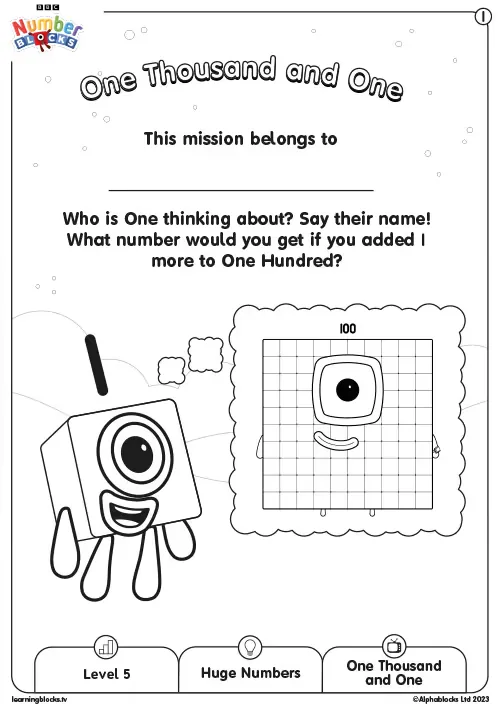
The source page also provides the learning sheet shown above and embeds the episode video. Those materials are stronger evidence for the episode title and learning prompt than a copied fan description. The listing itself does not provide a complete character biography or settle every fan-made detail, so this guide does not guess at a character's design, personality, or gender.
For the arithmetic, treat One Thousand as a number model. It can be represented by ten hundreds, a thousand ones, or a place-value chart with a 1 in the thousands column. These are equivalent mathematical descriptions, not statements that the show displays each arrangement. Keeping that boundary clear lets the page answer both the character lookup and the practical maths question without confusing official story material with an explanatory diagram.
How do ten hundreds make Numberblocks 1000?
A reliable way to understand one thousand is to start with a number that is easier to see: one hundred. Ten groups of one hundred make one thousand, so the multiplication is 10 × 100 = 1,000. The diagram below shows ten labeled groups. Each tile stands for a complete hundred; the tile is a counting aid, not a picture of one hundred tiny cubes or an official character formation.
You can check the total by adding one hundred ten times: 100 + 100 + 100 + 100 + 100 + 100 + 100 + 100 + 100 + 100 = 1,000. Counting by hundreds gives the same check: 100, 200, 300, and so on, until 1,000. If a learner loses track, point to one tile for each count. The model makes the number of groups visible before the individual units are drawn.
This grouped model also helps explain why a thousand is larger than One Hundred without suggesting that it is simply a taller hundred character. The quantity changes by a factor of ten. A 10-by-10 square can stand for one hundred units; ten such hundreds stand for ten times that amount. The important idea is the relationship between groups and total, not the physical size of a drawing.
10 × 100 = 1,000
What does each digit in 1,000 mean?
In the decimal place-value system, each position is worth ten times the position to its right. Starting at the right, the places are ones, tens, hundreds, and thousands. In 1,000, the digit 1 is in the thousands place and the three zeroes show that there are no extra hundreds, tens, or ones. The value is therefore 1 × 1,000 + 0 × 100 + 0 × 10 + 0 × 1.
A zero here is a placeholder with a real job. Without the zeroes, 1,000 would not mean the same thing as 100, 10, or 1. Read the number from its place values, not as four unrelated symbols. The chart shows how the written form expands into thousands, hundreds, tens, and ones.
This explanation uses base ten, the place-value system used for ordinary decimal numerals. A Roman numeral or a tally mark records quantity in a different way. Numberblocks makes quantity visible through blocks; place value explains why the position of a digit changes its value. Together, the two ideas help a learner connect a concrete group of objects with the compact written number 1,000.
| Place | Digit | Value |
|---|---|---|
| Thousands | 1 | 1 × 1,000 = 1,000 |
| Hundreds | 0 | 0 × 100 = 0 |
| Tens | 0 | 0 × 10 = 0 |
| Ones | 0 | 0 × 1 = 0 |
How is 1,000 different from 100 and 10,000?
The names are similar, but the quantities are different. One hundred is 10 tens. One thousand is 10 hundreds. Ten thousand is 10 thousands. Moving one place left in the decimal system makes the value ten times as large; moving one place right makes it one tenth as large. This is why the zeroes matter and why reading each place aloud can prevent a mix-up.
The word “thousand” names 1,000, while “one thousand and one” means 1,001 in ordinary number language. The official episode title is a story title, so do not assume that every appearance of the phrase is a lesson about writing the numeral 1,001. The learning sheet separately asks what one more than One Hundred would be; that arithmetic answer is 101. The episode title and the worksheet question are not interchangeable calculations.
Search results for Numberblocks 1000 can also lead to counting videos that continue far beyond one thousand. Those videos serve a counting-practice need. This page stays with the One Thousand episode context and the structure of 1,000; it is not a complete 1-to-1,000 chart, a list of every large-number character, or a generator for character artwork.
- 100 = 10 groups of 10.
- 1,000 = 10 groups of 100 = 100 groups of 10.
- 10,000 = 10 groups of 1,000.
A hands-on Numberblocks 1000 activity
Use ten paper squares, ten groups of counters, or ten small stacks of safe classroom objects. Label each group “100” and explain that the label represents a hundred items. If the learner is not ready to imagine a whole hundred, build one group as ten rows of ten marks first. That keeps the activity adaptable and lets the learner check the group before combining it with the others.
Ask the learner to predict the total before counting all the objects. Then count the groups by hundreds and compare that result with the multiplication sentence. The point is not speed. It is to notice that a repeated equal group can be counted as a unit. For younger children, stop after two or three hundreds and finish with a spoken pattern; older learners can write the full addition sentence and explain why it equals ten times one hundred.
If the learner gives 101 after seeing the official worksheet's “one more than One Hundred” prompt, that answer is correct for 100 + 1. It does not contradict the episode title One Thousand and One. Write the two expressions side by side if needed: 100 + 1 = 101, while 1,000 + 1 = 1,001. The starting number determines the answer.
- Make one hundredDraw ten rows of ten marks, or describe a prepared group of one hundred objects.
- Repeat ten groupsPlace ten hundred-groups in a row and count them aloud: 100, 200, 300, through 1,000.
- Write the equationRecord 10 × 100 = 1,000 and check it by repeated addition.
- Compare one moreWork out 100 + 1 and 1,000 + 1 separately to distinguish 101 from 1,001.
Watch the official One Thousand and One episode
The official episode page embeds a Numberblocks video for One Thousand and One. It is included here because the query has a clear character-and-episode component, and watching the source is the most direct way to see the programme's own visuals and story. This article's diagrams remain separate teaching models and are not frames from the video.
The episode page is hosted by Blocks Universe and links to external playback. YouTube availability, captions, regional access, and the player itself can change. If the embed does not load, use the official episode listing linked below; the written explanation and arithmetic on this page do not depend on video playback.
A short official synopsis cannot answer every question about how fans interpret a character. For that reason, this guide reports what the source page says and leaves unconfirmed biography details open. The video is evidence of the episode, not proof of every fan-wiki claim or every possible block arrangement.
Numberblock 1000, One Thousand, and 1,001 are not the same query
Numberblock 1000 is a character lookup phrase. One Thousand is the number name and character wording used in episode-related material. One Thousand and One is the official episode title. The numeral 1,001 is the value of one thousand plus one. Those terms overlap in search results, but each can answer a different question, so the page names the episode and explains the arithmetic instead of treating them as synonyms.
Likewise, “Numberblocks 1 to 100” usually asks for counting or a chart, while “Numberblocks 100” often asks about the One Hundred character. A character guide can explain a number relationship, but it cannot replace a counting video or a printable chart. Use the Numberblocks 100 guide for One Hundred, and the existing generator page when you want to build or compare a layout.
This is an informational fan guide, not an official BBC or Blocks Universe publication. The show image and episode embed come from the official episode page and are credited. The place-value statements are standard arithmetic that can be checked directly. Any additional character detail should be verified in the episode or a clearly identified fan-maintained source rather than inferred from the number model.
Numberblocks 1000 FAQ
Who is Numberblock 1000?
The search phrase commonly points to One Thousand and the official episode One Thousand and One. The official listing confirms the episode and premise, but it is not a complete character biography, so this guide does not add unverified design or personality details.
What does 1000 look like in Numberblocks?
For maths, model 1,000 as ten groups of one hundred or one thousand ones. The diagrams here show those quantities; they are original teaching visuals, not official character poses or screenshots.
Does the official source say whether One Thousand is a boy or a girl?
The official episode page reviewed for this guide does not specify the character's gender. Check the episode itself for its portrayal rather than treating an unverified fan description as an official fact.
What number is one more than One Hundred?
One hundred plus one is 101. That is different from one thousand plus one, which is 1,001; the starting number changes the result.
How do ten hundreds make one thousand?
Multiply 10 groups by 100 in each group: 10 × 100 = 1,000. You can verify it by counting 100, 200, 300, and continuing to 1,000.
Official episode reference
This guide distinguishes the show's episode material from the arithmetic models used to explain the number.
- Blocks Universe: One Thousand and One — Official episode listing, short synopsis, learning-sheet image, and embedded video; checked 7 November 2026.
Numberblocks and its character artwork belong to their respective rights holders. This independent guide uses an attributed official learning-sheet image and explains arithmetic; it is not an official programme page.